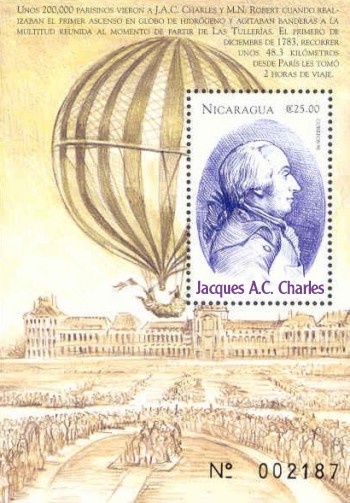
 Professor A. C. Charles
After
the successful demonstrations of Joseph and Etienne Montgolfier
scientists threw themselves on the subject to discover what physical
phenomenon really caused the rising of the balloons. It was a Parisian
physicist, Professor Jacques A.C. Charles, who found out hot air
was lighter than cold air and thus lifted the balloon. It occurred to
him there had to be other gases who were lighter than air and therefore
able to produce the same effect. A balloon filled with the very
light-weight hydrogen gas should have the same lifting-power as a hot
air balloon. A 40m3 balloon was made for him by two engineers, the
Robert brothers. These men had found a way to make fabrics air-tight
by rubberizing them. They treated silk with their product and
constructed a balloon with a diameter of only 4 metres. The next problem
to solve was the production of enough hydrogen gas. The brothers placed
a big barrel in their garden, filled with iron filings. Covering the
filings with thinned nitric acid they became hydrogen,
that was piped into the balloon. It took them 3 days to fill the
balloon. On August 25th 1783 it climbed to a height of 30 metres, in the
presence of thousands of enthusiastic Parisians. This first attempt was
made while the balloon was cabled, but the success of the experiment
aroused the desire to let the balloon make a free flight. This event
took place on August 27th 1783 at the Champs de Mars, where no less than
300.000 Parisians had gathered to watch. It was a cold and stormy
morning; strong winds and heavy rainfall prevented the release of the
balloon. Nevertheless the gathered people were cheerful and their amount
still increased. By the end of the afternoon the sky cleared and the
“Charlière”
majestically rose to a height of 1000 metres. Then it disappeared out of
sight. After a flight of 25 kilometres the brightly painted balloon
landed slowly in a field near the village of Gonesse. The farmers who
were harvesting in the fields were of a rather superstitious nature and
immediately thought of an attack by demons, ghosts, monsters. Most of
the villagers fled into the church but a few brave men armed with
hayforks attacked the monster and vanquished it. Soon there was no more
left of the poor balloon but some torn rags…
To prevent further incidents the
government promised a reward to anyone who delivered a found balloon as
intact as possible at the town hall. In the mean time the ragged balloon
had been collected and sent to professor Charles for examination. He
found a large tear that could not be a result of the heroic attack of
the angry farmers. Therefore he concluded the tear must have been due to
expansion of the gas and caused either by the lessening
atmospheric pressure or the warming of the gas by the sun.
The very successful flight of the
“Globe” - as Charles had baptised his balloon - signified also the start
of a real competition between the gas balloon and the hot air balloon. |



