|
 A
dream as old as mankind itself A
dream as old as mankind itself
It has always been man’s biggest dream to be able to
fly. He observed the flight of the birds, wondered and experimented.
However, many centuries went by and many experiments ended in the
graveyard before human flight became reality. And when he at last
managed to do so, man didn’t fly like a bird at all, he floated like a
cloud.
It’s the invention of the balloon that finally realized the age-old
dream of mankind...
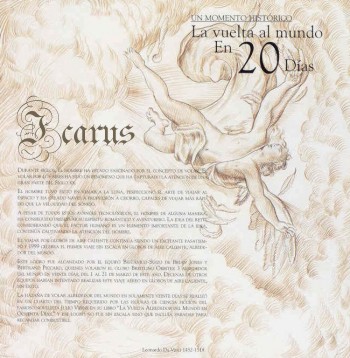
The most popular of all Greek legends is the one of
Daedalus and his son Icarus.
They were kept prisoners on the island of Crete by
the cruel king Minos. Driven by their strong desire for freedom Daedalus
devised a plan to escape from Crete. He designed wings made from
feathers bound together with wax, which he planned on using to fly away
from the island. Icarus however, thrilled with the power of flight, flew
too near the sun and the wax melted. The boy fell into the sea and
drowned.
Henry Cavendish (10-Oct-1731 Nice – 24-Feb-1810 London) was an English physicist. Being a son of Lord Cavendish he was
very wealthy and for that reason able to work independently and to
experiment without any restrictions. He discovered hydrogen gas in 1766
and nitrogen in 1772. Hydrogen gas is very inflammable in combination
with air. That’s why the gas was handled with the utmost caution.
Because of this in flammability the French called it “air inflammable”,
the Germans called it “Knallgas”. According to Cavendish the weight of
hydrogen gas was only 1/14 of air. Being aware of the explosive nature
of the gas he called it “phlogiston”, which in the 18th century was the
name of the element scientists thought to be present in all inflammable
substances. Even though Cavendish already mentioned the lighter-than-air
nature of the gas, no one realised at that time that it would enable
aviation using airships.
In 1781 Tiberius Cavallo (1749-1809) filled
animal bladders with hydrogen gas but when his tests failed he
experimented with soap-bubbles he filled with hydrogen gas. The bubbles
mounted quickly and the year after Cavallo described his experiences in
an assembly of the Royal Society, amid many marks of sympathy. In the
same year a definitive step was taken in the development of the first
balloon. Remarkably it was hot air that created the necessary
lifting-power and not the new hydrogen gas. |


