|
 The
“last” challenge The
“last” challenge
From
the earliest days of ballooning people have been looking for new
challenges. Jean-Pierre Blanchard and Pilâtre de Rozier wanted to cross
the Channel (between England and France) in their balloons. But even
today it is the dream of many balloonists to do this. Especially the
crossing from France to England is a challenge because it is so easy to
miss land and to end up in the sea.
The
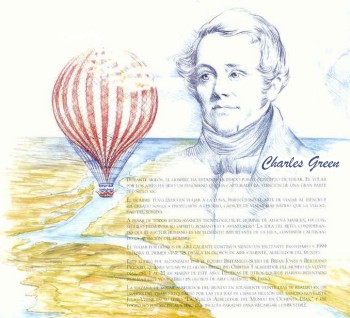
next challenge was to “conquer” the Atlantic Ocean. The most famous 19th
century aeronauts, Charles Green (England) and John Wise
(America), had the same wish: to be the first person to make a
transatlantic balloon flight. Green was an expert concerning western
winds but he never made the trip. He made his most famous flight on
November 7th and 8th 1836: he travelled 480 miles
from London to the German duchy Nassau in a 70.000 cubic feet balloon
that was baptised ‘Nassau’ afterwards.
Hoping to prove that it was possible to cross the Atlantic Ocean from
west to east, Wise and three passengers left from St-Louis on July 1st
1859 for a test flight above the mainland. After 1285 kilometres they
were caught in a storm and had to land on Lake Ontario. The balloon was
dragged ashore by the wind and torn to pieces in the woods. For half a
century no one could beat this distance record.
The
first serious attempt to cross the Atlantic Ocean only took place in
1958 by Colin Mudie, his wife Rosemary, Bushy Eiloart and his son Tim.
They made the trip in a gas balloon called ‘Small World’ and
containing 53.000 cubic feet of hydrogen. After 2223 km they landed in
the ocean and had to use their nacelle as a life-boat to end their
journey.
Altogether 14 attempts would be made before a team finally succeeded. In
1978 Maxie Anderson, Ben Abruzzo and Larry Newman flew from America
(Maine) to France (Evreux). Their ‘Double Eagle II’ covered 4997
km in less than 6 days.
And
after the Atlantic Ocean followed the Pacific Ocean…
|