|
Balloon fever
Less
than two months after the birth of navigation, a Belgian already went up
into the sky. Prince Charles-Joseph de Ligne was the first
non-French citizen to go on a flight in a hot air balloon. The Science
Academy of Lyon asked Joseph Montgolfier to construct a huge balloon,
able to carry 6 people at once. It got ready for its first flight on
January 16th 1784. Jean François Pilâtre de Rozier would be
the pilot, and he would be accompanied by Joseph Montgolfier, the
noblemen count De Dampierre, count De Laurencin, lieutenant-colonel
count Laporte d’Anglefort and the Belgian prince Charles-Joseph de Ligne.
A first attempt was aborted because snow and icing had increased the
weight op the balloon.
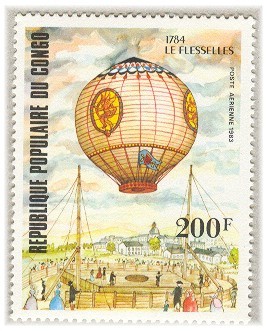
On
January 19th de Rozier decided to make a second attempt to
fly. The weather conditions had weakened the envelope that was made of
canvas and paper. For that reason de Rozier decided to take only three
passengers instead of four. The story goes that the four noblemen
promptly draw their swords to defend their places. De Rozier was left no
option but to ascend with the heavily loaded balloon. And at the moment
the balloon left the ground a young man from Lyon, named Fontaine,
jumped in the balloon. The extra weight and the fact that the assistants
forgot to cut two ropes almost caused a disaster. The balloon dragged
along the grass and for a moment it looked as if it would end in the
trees. Yet the pilot managed to get the ‘La Flesselles’ up in the air
while at least 100.000 spectators were cheering. But all of a sudden a
large tear appeared in the balloon. As it grew larger and larger the
balloon dropped to the earth and caught fire. Luckily the brave
passengers survived this ordeal and the city of Lyon celebrated the
heroes all night long.
The
balloon fever spread outside France too. Even though the English called
the French flights foolish and of no use at all, an Italian used the
Montgolfier technique to launch a small balloon on English soil on
November 25th 1783. One year later experiments were carried
out in Italy, Austria, Scotland and America.
 Yet
France kept providing the most important news facts. The man responsible
for this was Jean-Pierre Blanchard, the first professional
aeronaut. He conducted important experiments to make a steerable
balloon. In a first attempt he fixed a self-made nacelle to a balloon.
That nacelle had oars with the aspect of wings, it had a rudder and a
parachute. Using these attributes direction, speed and height would be
controlled by Blanchard himself. Yet
France kept providing the most important news facts. The man responsible
for this was Jean-Pierre Blanchard, the first professional
aeronaut. He conducted important experiments to make a steerable
balloon. In a first attempt he fixed a self-made nacelle to a balloon.
That nacelle had oars with the aspect of wings, it had a rudder and a
parachute. Using these attributes direction, speed and height would be
controlled by Blanchard himself.
But
as his experiments were unsuccessful it would take over 100 years before
an airship would really be able to fly against the wind. Blanchard then
emigrated to England and conceived the plan to cross the Channel in a
balloon. In France Pilâtre de Rozier had developed exactly the same
idea.
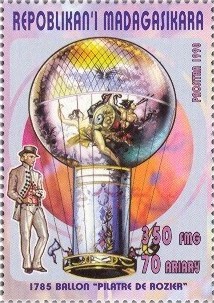
Again
they ended up in a race against time. Pilâtre de Rozier who, starting in
France had to cross the Channel against the western wind and Blanchard
who, leaving in England would have the wind in his back. It is Blanchard
who succeeded in making the first flight across the Channel on January 7th
1785, in the company of Dr. John Jeffries.
And
Pilâtre de Rozier? He had to wait until the wind turned to a
better direction. In his balloon (a dangerous combination of a hot air
balloon and a gas balloon, because of the open fire close to the very
inflammable hydrogen gas) he climbed with his companion to a height of
1500 meters. And then the nightmare became real: the balloon caught
fire. The world’s first aeronaut crashed before the eyes of many
spectators. Nineteen months after his first glorious flight his accident
was also the first fatal one to be remembered. |



