|
Dreaming of a
non-stop flight around the world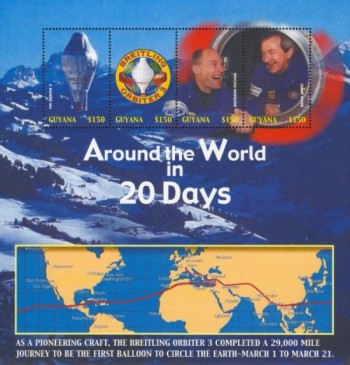
The
first effort in 1981 was not successful, nor were the 20 other ones.
Several distance and time records were broken but the real goal was
never achieved. The world had to wait until 1999, when Bertrand Picard
and Brian Jones circumnavigated the world in the Breitling Orbiter III.
After 20 exciting days this “last” challenge was brought to a successful
conclusion.
In
2001 Steve Fossett also flew around the world, but he did it alone and
in 15 days. Picard and Jones had used a pressurized cabin; Fossett used
an “ordinary” gondola. This implied that he had to wear an oxygen-mask
half of the journey (when flying above 4000m). Moreover he was the first
man to make his attempt over the southern hemisphere where he found
himself surrounded by water for 95% of the time. Doing the possibility
to miss land at the finish was very big. The rules being that one has to
finish on the mainland, a landing at sea would have signified the
failure of the entire venture.
|
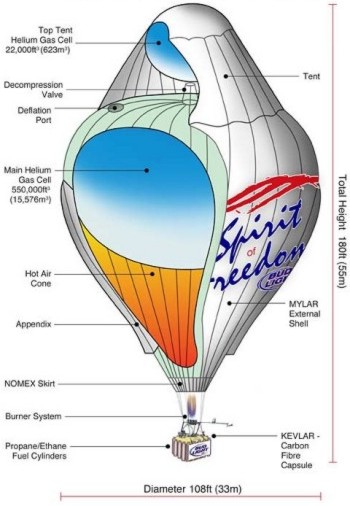
The balloon used for this kind of flights uses a combination of
helium and hot air to fly, a design known as a Rozière balloon. The
balloon envelope is 140 feet tall and 60 feet wide. It contains
550.000 cubic feet of helium plus 100.000 cubic feet of hot air. It
contains no engine; the balloon is powered solely by the wind. Tanks
of fuel, a mixture of propane and ethane, hang from the outside of
the gondola. The pilot steers the balloon by ascending or descending
to catch winds blowing in the desired direction. The gas cell is
filled only half with helium. When the balloon rises, helium expands
by the heat of the sun and the lower atmospheric pressure. If the
pilot wants to descend, he lets helium gas escape through the valves
on top of the gas cell. At night he uses fuel to heat the warm air,
which in its turn warms up the helium. Like this the balloon can
climb higher even at night.
Gas balloons can also stay up in the air for several days. It is
absolutely possible to perform flights of 3 or 4 days. But a gas
balloon has the tendency to descend when the sun doesn’t warm up the
gas inside. The pilot can slow down or stop this spontaneous descent
by throwing out ballast. For a journey around the world you would
need a tremendous amount of ballast. In a Rozière the lack of
sunshine is met by heating the air around the gas cell, so there is
no ballast needed.
Combining a gas balloon and a hot air balloon was considered in the
beginning to be a fool’s idea. But without this invention no one
would probably have been able to fly non-stop around the globe in a
balloon.
And the difference? Pilâtre de Rozier used the highly flammable
hydrogen gas, nowadays the inflammable (but very expensive) helium
is being used. |
 And
now what? People are already carrying out experiments to reach extreme
heights… Although this is not new either. The Swiss Auguste Piccard,
professor at the University of Brussels, carried out some scientific
balloon flights in the early 1900’s. These experiments were highly
supported by the Belgian
National Fund for Scientific Research. And
now what? People are already carrying out experiments to reach extreme
heights… Although this is not new either. The Swiss Auguste Piccard,
professor at the University of Brussels, carried out some scientific
balloon flights in the early 1900’s. These experiments were highly
supported by the Belgian
National Fund for Scientific Research.
For these tests he
had constructed a large stratosphere
balloon. On May 27th 1931 he reached a height of 15.781
metres. This was the very first balloon flight in a pressurized cabin.
On August 18th 1931 he reached a height of 16.201 metres. But
even this record has been broken in the mean time.
|



