|
|
|
|
|
| |
|
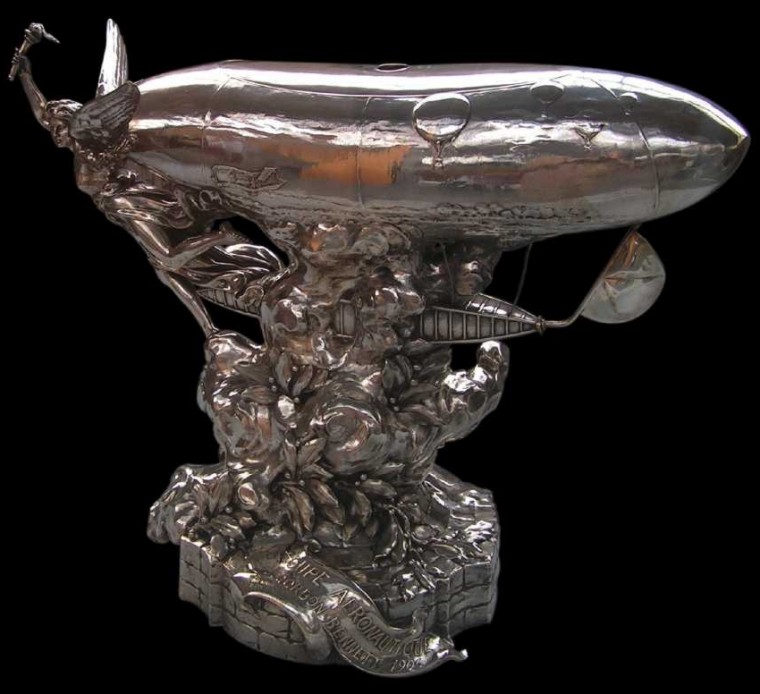
The Coupe Aéronautique Gordon Bennett |
|
The most famous winners are
- 1985-1993 Josef Starkbaum, Austria: 7-fold winner
- 1920-1937 Ernest Demuyter, Belgium: 6-fold winner
- 1997-2003 Vincent and Jean-François Leÿs, France: 4-fold winner
- 1995-2000 Wilhelm Eimers, Germany: 3-fold winner
Rule is that the winner of the trophy can keep the trophy during the coming year, and must hand it to next years’ winner.
The country that gets the trophy for 3 consecutive years can keep it.
|
| |
|
|
Ernest Demuyter won the 1922,1923 and 1924 Gordon Bennett Coupe and Belgium could therefore keep the most beautiful silver objet d’art ‘for ever’.
New trophies were made and changed ownership yearly except for those countries who had won the Coupe Gordon Bennett for three consecutive years: the United States of America both in 1928 and in 1932, Poland in 1935, Austria in 1987 and in 1990 and France in 2003.
‘Coupe’-victories
| Belgium |
1922 |
1923 |
1924 |
| USA |
1926 |
1927 |
1928 |
| USA |
1929 |
1930 |
1932 |
| Poland |
1933 |
1934 |
1935 |
| Austria |
1985 |
1986 |
1987 |
| Austria |
1988 |
1989 |
1990 |
| France |
2001 |
2002 |
2003 |
Click here for details
So far the race has been held 50 times, out of which
9 times in Belgium |
| |
|
1906
It is scarcely necessary to remark that no contest of similar importance had ever been held before in the
history of aeronautics. The first Gordon Bennett Race started from the Tuileries Gardens in Paris on September
30th. From dawn onwards, the biggest crowd ever assembled in Paris for one event had begun to fill the
Tuileries and the Place de la Concorde. The bridges over the Seine and the house-tops all around were black with
spectators. Sixteen balloons, requiring over a million cubic feet of coal gas, were inflated before a crowd of
200.000 people.
At exactly four o’clock, the Italian silk balloon ‘Elfe’
rose gracefully from the starting point. The beautiful balloon was released upon the firing of a gun by Mr.
James Gordon Bennett Jr. The other monsters bobbed and swayed at their moorings, waiting for their designated
moment of departure before taking off at five minute intervals. It was a marvellous autumn day in Paris, a
real French fête.
The Americans Lahm and Hersey won.
Amongst the participants two Belgian-French teams. One was the Belgian Van de Driessche, one was Count Hadelin
d’Oultremont, who would later on become president of the Belgian Aero-Club. It was d’Oultremont who, in 1907, had
the honour to fly with Prince Albert of Belgium, who would a few years later become king.
|
|
|
1907
America went wild with excitement. It had never had an International balloon race before. Departure from
Saint-Louis – Missouri – USA. The reason why Saint-Louis had been chosen for this long-distance
race was that, the city being so far from the sea, there could be no danger of anyone landing in the ocean.
There was a fresh wind at take-off and later on the moon shine brilliantly. The conditions seemed ideal for
record-breaking flights.
No Belgian participant. The Germans win with a distance of 1403 km.
|
|
1908
Departure from Berlin. Three Belgians teams participated, but the Swiss Schaeck and Messner won, with a 1212 km
long flight into Norway. They were up in the air for 73 hours.This year would be a major step in the Belgian
Ballooning history: the Belgian Balloonist Léon Gheude took the 15 year old Ernest Demuyter for a trip in his
balloon, and the boy was immediately addicted.
|
|
1909
It was Zürich that had the honour of holding the ‘Race of the Champions’. The public interest was impressive.
Trams carried 400.000 spectators to the start. The Swiss Aéro Club made this the biggest air show to date. It
organized competitions for 68 balloons.
Three Belgian teams participate: De Brouckère, Geerts and Vléminckx. The Americans Mix-Russel win the race
landing in Russia after a flight of 1140 km.
|
|
|
1910
The Gordon Bennett Race was held at Saint-Louis, USA.
Ten teams participated. The Americans Hawley and Post
managed to make a flight of 1887 km. They landed among
the Indians somewhere in the Canadian jungle. It took
them a four-day march before they found a lonly hunter.
The German balloonists von Abercron and Blanckertz even
had to walk for ten days. They left the balloon in the
woods, where it was found by Eskimos three months later.
Departure and winning team: USA |
|
1911
The Americans were winners in 1909 and in 1910, so it
could be expected that they would do their utmost to
win. So they would be awarded the Gordon Bennett trophy
for the third time in succession. This would have
qualified America to retain the Challenge Cup outright.
So France and Germany announced that they would
participated with the best crews and the best balloons
that could be found. The German engineer Hans Gericke
flew for ten hours in his open basket in snow and rain.
This was a most impressive feat and it qualified him as
winner. The race out of Kansas City (USA) was won by
Germany.
No Belgian participants for the second year. |
|
|
1912
What was most memorable from this race out of Stuttgart?
For The World it would be the victory of the French team
Bienaimé-Rumpelmayer, flying 2191 km, landing in the
vicinity of Moscow. This distance record will stand for
93 years ! |
An American pilot was jailed in a Russian prison and was
refused contact with the American consul for several
days.
But for the Belgians it would be the first participation
of the man who would bring fame and glory to Belgium as
a balloonists’ country: the 19 year old Ernest Demuyter
flew 1200 km. A good warming up for more to come! |
|
1913
With Paris as take-off Demuyter-Vléminckx achieve
seventh position. The race is won by the Americans
Upson-Preston. They were the only ones to reach England.
All others landed in France.During World War 1 no
Gordon Bennett will be organised, but Ernest Demuyter
wins several prizes in other ballooning competitions,
and this makes him ready to win the 1920th Gordon Bennett Race |
|
|
1920
Gordon Bennett out of Birmingham, USA. With Labrousse as
co he will land his balloon ‘The Belgica’ far ahead of
his competitors. Demuyter has, more than any other pilot
of his era, studied the winds. In those days few
balloonists knew, before take-off, where they were
approximately heading for, but Ernest Demuyter knew how
to take advantage of winds turning around a low- or
high-pressure area. |
|
1921
Departure from Brussels. Demuyter and Veenstra see all
their chances for winning out of their home country
disappear as, during take-off, they discover a soldier,
who had come to help build up the balloon hung to their
basket. Demuyter was able to pull the young man aboard,
but with this extra weight on board, no chance to win!
The Swiss Armbruster and Ansemier win by landing their
balloon on a little island on the Irish coast. |
|
1922
Demuyter-Veenstra get their revenge! Departing from
Geneva they land their balloon in Rumania, and this 1372
km proves to be the best result.During this same year
Demuyter will break two time records. |
|
|
1923
Departure from Brussels with extremely bad weather. Five
balloonists will be killed in a severe thunderstorm: two
Americans: US Air Service officers Robert Olmsted and
John Shoptaw on Dutch territory, two Swiss (Gruningen
and Wehren) in Mol, Belgium, and one Spanish pilot (Penaranda)
in Heist-op-den-Berg, Belgium .Demuyter and
Coeckelbergh fly 1155 km into Sweden and win. |
|
1924
Will Demuyter bring the Coupe Aeronautique to Belgium
definitively? The aims are high!
Departure is from Brussels. Soft winds.
Demuyter-Coeckelbergh make a 43 hr journey zigzagging
over Europe: first heading southwest to Charleroi, Reims,
nearly Paris, then heading north, crossing the Channel
into Brighton, further and further into England
finalising their journey near Edinburg, Scotland. The
direct distance Brussels-Edinburg is ‘only’ 714 km, but
no other pilot did better and this result brings the
Coupe, originally handed by James Gordon Bennett 16
years before to Belgium for ever!
The Belgian population is euphoric. King Albert
congratulates the hero.
The Coupe can be seen in the Belgian Air Museum. |
|
1925
Another take-off from Brussels. And another victory for
Belgium. Yet not for Demuyter –Coeckelbergh: they end
second after the Belgians Veenstra – Quersin. |
|
|
1926
Departure from Antwerp. Three Belgian Teams participate.
Demuyter will end third. Winners are the Americans van
Orman – Morton. |
|
1927
The Coupe starts in America (Detroit) and is won by
Americans (Hill-Schlosser). Demuyter ends sixth. |
|
1928
Another start from America (Detroit), another victory of
Americans (Kepner- Eareckson) |
|
1929
Third consecutive start from America (St Louis, Texas),
ànd THIRD victory for Americans: van Orman –Mc.Cracken.
America will keep the second Coupe definitively. They
will have to hand a new Coupe to next years winners… |
|
|
1930
Fourth consecutive take-off from America and fourth
victory of Americans. van Orman -
Mc.Cracken confirm their previous years position.
Demuyter- Coeckelbergh will end second. |
|
1931
Europe suffers heavily from the financial crash. The
Coupe Gordon Bennett is cancelled. |
|
1932
It was decided to start this race in Basel (Switzerland).
This could not refrain the Americans to continue their
triumphal march. The third Coupe will go to America !! |
|
|
1933
Departure from Chicago. An American team landed in a
dense forest and had to hack their way through the
forest for 11 days to reach civilisation
The Polish Hynek and Burzinsky beat the Americans! It
will prove the beginning of an all-Polish success story! |
|
1934
Departure from Warschau. The Polish Hynek-Pomasky fly
1330 km. Demuyter-Coeckelbergh are third with 1172 km. |
|
1935
Second departure from Warschau, and third victory for
the Polish! The new Coupe, offered by the Americans will
definitively belong to Poland. |
| This is the fourth
occasion for a country to be able to keep the Coupe
permanently.
Demuyter and Hoffmans flying the new ‘Belgica’ balloon
end third. |
|
1936
Third departure from Warschau and fifth victory for
Demuyter! They flew 1715 km all to Arkangelsk. |
|
|
1937
Departure from Brussels. Three Belgian teams will
compete, but The Best wins overall: Demuyter flew 1396
km all through Letland. |
|
1938
Departure from Liège (Belgium). Will Demuyter bring a
second Coupe to Belgium? The three participating Belgian
teams reach distances of 1026, 1336, 1463 km, but the
victory goes to the Polish team Janusz-Janick with 1692
km. |
|
| 1939 |
Warschau is ready to launch the Gordon Bennett, but the
race is halted by the beginning of the Second Word War. The War made an end to these peaceful tournaments, full
of grandeur, where balloonists flew all over the world –
not worrying about frontiers.
The post-war period would not enable these
frontier-crossing flights.
It looked as though the Coupe Aéronautique Gordon
Bennett would be over for ever. |
|
|
1983
The ballooning community shared their efforts, and on
the occasion of the 200th anniversary of ballooning The
Coupe Gordon Bennett started over…
Just like the very first time in 1906: out of Paris.
The French organisation was impeccable.
Everything was done to make this renewal unforgettable:
Half of the Place de la Concorde was free of traffic.
All traffic in Paris, and above Paris, in the air, was
adapted to enable the Gordon Bennett!
All was well prepared but the weather is always
unpredictable: while the balloons were being filled with
gas the sky turned dark. Heavy thunderstorms were on
their way to Paris, yet three teams decided to take an
early take-off. Two of them landed within one hour, but
the third, the American team, was smashed out of the air
close to the East-German border. Both pilots, Don Ida
and Maxie Anderson, were killed.
The thunderstorm had passed Paris in full force. All
balloons on the ground suffered great difficulties to
remain upright and tied, and several balloons had to be
repaired and refilled with gas.
The Polish team won the race by landing close to
Tsjechia after a 36 hours’ flight. |
|
|
1984
The Swiss Karl Spenger- Martin Messner won, out of
Switzerland |
|
1985
Josef Starkbaum of Austria won, flying from Geneva to
Marseille. |
|
1986
9 teams competed out of Salzburg: one Austrian, 3 Swiss,
3 German, one French and one American team: David Levin
and Frank Rider. David Levin will be this events’ Deputy
Director
The German team of Schröter and Peters landed their
balloon close to Nürnberg, but all others headed east.
The Hungarian and Yugoslavian airspace was open |
| to this
race, but the Tsjechian was not.
This year would result in the shortest distances ever
flown in the history of the Gordon Bennett. Starkbaum
won, having flown a mere 271 km. |
|
1987
Departure Austria. The Austrian Starkbaum won.
His third victory! The fifth Coupe belongs to Austria
for ever! |
|
1988
Departure Austria. The Austrian Starkbaum won. |
|
1989
Departure Austria. The Austrian Starkbaum won. |
|
1990
Departure Austria. The Austrian Starkbaum won.
His balloon, the netless Polarstern landed in Pescara,
Italy which made 692 km.
Second was the US team with their Aspen balloon. They
landed in Yugoslavia after 605 km.
The sixth Coupe belongs to Austria for ever. Mann, ist
der Starkbaum stark ! |
|
1991
Departure Lech am Arlberg, Austria.
The balloons took off towards Poland. In spite of the
recent Glasnost it was still forbidden to enter Russian
airspace. Starkbaum&Scholz came quite near to the
Russian border, but it was the German team of Kuinke &
Schubert that broke the Austrian hegemony after a 1024
km flight. |
|
1992
For the first time in 80 years the Coupe Gordon Bennett
took off from Germany.
Three netless balloons were in the race: two Austrian’s
and one Polish.
Unfortunately the Polish balloon would be destroyed in a
fire upon landing..
Winners of this race would be the Americans David Levin
and Jim Herschend. They landed in Poland. The Austrian
pilot Gerald Stürzlinger was in their ground crew, and
the German Petra Oberzig was the observer who could
announce that thanks to this flight the USA would next
year be allowed to organise the first post war Gordon
Bennett on US territory.
David Levin would, three weeks after, in Austria, become
World Gas Balloon Champion! |
|
1993
Take-off from the worlds most famous Balloon Fiësta
place: Albuquerque, New Mexico, USA.
Some 650 hot air balloons filled the air daily on the
days prior to the start of the Gordon Bennett. The
distance results showed large differences. Last in the
ranking was a balloon that had flown 10 km in 11 hours!
David Levin ranked 18th with 80 km. But Josef Starkbaum
flew…1832 km! His seventh Gordon Bennett victory! No
other pilot won this race that often! |
|
1994
The race started in a snow-covered Lech am Arlberg!
The wind was very weak, and 5 out of 15 participants
landed in the close-by valleys: Oetztal and Pitztal. The
others flew further south to the border of the Italian
mainland, along the Gulf of Genua. The Swiss
Spenger-Stoll decided to fly over the Gulf and try to
reach Corsica or Sardinia. Yet the wind blew the too far
westward.
Only by climbing up to 5800 m. they found easterly winds
allowing them to land on Sardinia. They had reached 825
km and won the race. |
|
1995
Departure from Wil, Switzerland.
Russia was, as mostly, prohibited airspace and territory,
but approvals had been obtained to fly over The Baltic,
Belarus and Ukrania.
Most balloons headed towards Germany and Poland. The
Austrian team landed in Ukrania. The German Team of
Eimers & Landsmann landed in Letland, 3 km before the
Russian border. This 91 hours flight made Willi Eimers
time record holder (the previous record was set in 1908
out of Berlin with 73 hours flight). |
|
So this race would have been most interesting in terms of distances
and time had there not been the drama over Belarus.
Three American balloons entered the Belarus territory
early in the morning, after having transmitted their
position to the Minsk air traffic control.
One of these three was the Virgin Islands team of Alan
Fraenkel and John Stuart-Jervis. Alan Fraenkel was an
enthusiast balloonist who developed the ‘Windreader’: an
instrument allowing to read the direction and speed of
the wind on different altitudes very precisely.
Before entering the Belarus territory the Minsk reply
was in hardly understandable English; upon entering the
territory Minsk first replied in Russian only, later on
they did not reply at all.
The teams of Levin & Sullivan and of Wallace & Brielman
were forced to land by the military authorities.
A military helicopter approached the ‘D-Caribbean’. |
| The helicopter tried to contact the ballooning team in
Russian, circled around the balloon for nearly half an
hour and then opened fire! The balloon and the basket
were hit by some 20 bullets. The balloon crashed in a
forest and Alan Fraenkel and John Stuart-Jervis were
killed. |
|
1996
Departure from Warstein, Germany.
The weather was very bad. Many balloons had to land in
Germany, Poland or Tsjechia because of the weather. But
Willi Eimers again flew 3 nights, landed his balloon
after 1286 km, and won the race! |
|
| 1997 |
|
Another departure from Warstein.
Russia and Bulgaria were closed territory. Rumania was
open.
Both German teams: Eimers / Landsmann and Brachtendorf /
Huthmacher landed their balloon in the swampy delta of
the Danube, in the East of Rumania.
Both the American team of Levin / Sullivan and the Dutch
team of Rien Jurg and Ron van Houten landed precisely on
the Rumanian-Bulgarian border.
But the French team, Vincent Leÿs and his brother
Jean-François Leÿs won the race by landing their balloon
200 meters further, on the beach of the Black Sea. |
|
1998
Take-off from the Tuileries in Paris.
The Gordon Bennett event coincided with the 100th
anniversary of the French Aeroclub, and on this occasion
the whole Champs Elysées were bordered by 50 historical
planes.
A great setting, but the weather was very unfavourable,
and for the first time in history the Gordon Bennett
race was cancelled for meteorological reasons. |
|
1999
Departure from Albuqerque, USA.
61 years after the last Belgian participation to the
Gordon Bennett (Liège, Belgium, 1938) THE BELGIANS ARE
BACK!
Philippe De Cock and Ronny Van Havere, very experienced
hot air balloon pilots, very successful hot air
competition pilots so far, have eagerly listened to the
great stories of Albert Vanden Bemden, a famous Belgian
balloonist, who, before anyone else, flew his balloon
over the Alps in 1962, and made hundreds of gas balloon
flights. Albert was a romantic man, a great story-teller.
He was the link between the former Belgian gas balloon
pilots, Ernest Demuyter on top, and the ‘modern’
community of hot air balloonists.
The adventure, the grandeur, the difficulty of long
distance gas balloon races made Philippe and Ronny very
eager to start flying gas balloons.
Their netless balloon, the ‘Belgica II’, referring to
the ‘Belgica’ of Ernest Demuyter, is very lightweight,
their basket is light-weight and they have fine modern
electronic devices on board. Their meteorologist is Luc
Trullemans, the Belgian meteorologist who acquired world
fame by guiding the ‘Breitling Orbiter 3’ around the
world.
They expressed their ambition very strongly: ’61 years
later….we’re back!’The balloons took off east.
Thunderstorms reached Oklahoma. 10 out of 20 balloons
landed before or during the second night under difficult
conditions.
But Luc Trullemans guided the Belgians high above the
thunderstorms, in a very fast current.
The Belgian team landed the ‘Belgica II’ in Amory,
Mississippi, having flown 1666 km.
The Belgians were back indeed!
They won the Gordon Bennett!
How proud they were! How proud were all Belgian
balloonists, and especially: how proud were Albert
Vanden Bemden and his wife Fientje. What more can an
elderly man hope for but to teach eager youngsters and
make them even bigger than himself ? |
|
2000
The last time the Gordon Bennett departed from Belgium
was 62 years ago!For the first time in the history of
the Gordon Bennett no observers flew on board. A ‘black-box’,
a sealed GPS-logger, would register the position of the
balloon. |
|
The winds were turning all directions.
The Germans Hora & Löschhorn flew to Calais. They
aimed at crossing the Channel, but 10 km before reaching
England the winds blew them back in Northerly direction
towards the North Sea. In the middle of the night they
had to make an emergency landing, 70 km out of the Dutch
mainland, in the North Sea. The Dutch coastguard rescued
the pilots, their basket and their balloon.
The second German team Eimers & Landsmann also headed
for France, but very slowly. After 29 hours they reached
Paris. The night crossing of this City of Light was like
a fairy tale. But the fairy tale soon ended as they were
afterwards blown all along the Belgian and Dutch
coastline, over water. The winds were strengthening and
they landed the balloon near Malmö.
They were the winners with 795 km.
|
|
The Belgians got no further but the North of France. |
|
| 2001 |
|
Another departure from Warstein.
After having flown three nights 4 balloons were in the
vicinity of Bucarest. Belgium, France, Holland and USA.
Only one team flew all through the fourth night: The
Leÿs brothers landed their balloon on a little island in
the Danube, and won the race. The Dutch team of Rien
Jurg and Ron van Houten were second. Philippe De Cock
and Ronny Van Haver were third. |
|
2002
Châtellerault, a little town between Tours and Poitiers,
would host both the Hot Air World Championship and the
Gordon Bennett.
David Bareford (UK) won the hot air competition.
The take-off of the Gordon Bennett was honoured with the
presence of Bertrand Piccard, the man who flew his
Breitling Orbiter around the world in 1999.
The winds were this year blowing from the Northeast, an
unusual direction for the Gordon Bennett: the balloons
would head towards Spain. |
|
The balloons took off just after midnight and half of
them landed before sunset of the same day in
South-Western France – Northern Spain.
The longest in the air was ‘Le Petit Prince’: the
balloon the Leÿs brothers had built themselves. They
headed for La Coruna and everyone believed they would
land on this very north-western part of Spain.
But the balloon made no attempts for descent. It flew
high and far over the Atlantic Ocean, maintaining its
south-westerly direction. The tension was high. They
were 400 km ocean-inward! |
Would they head for Madeira? For the Azores? Or should a
rescue at sea be prepared?
Three man must have had extreme confidence in each other:
Vincent and Jean-François ànd their meteorologist: Luc
Trullemans.
Luc Trullemans trusted on winds heading back south and
later on eastwards. And after a nerve-breaking other
night and other day ‘Le Petit Prince’ landed two
kilometres inland Portugal!With this very brave flight they scored 1282 km, the
double of most other balloons, and could bring next
years Gordon Bennett back to France! |
|
2003
Arc-et-Senans in the French Jura would host the event.
A second Belgian team would enter the competition: Bob
Berben and Benoît Siméons, flying their balloon ‘Miche’
named after Bob’s wife.
Again the balloons would head south-west.
The wind was extremely strong. A Swiss balloon was
damaged prior to take off and could not fly. The second
Swiss team also decided not to take off in view of the
strong winds.
The take-off around 02:00 in the morning was very
turbulent. The balloons could not be brought to the
podium. |
|
They each in turn had to wait for a little
decrease in wind speed, and it took 2,5 hours for them
all to be air-borne.
Ten balloons landed in France.
Only Wagner / Scherzer (A), Leÿs / Leÿs (F), De Cock /
Van Havere (B), Abruzzo / Johnson (USA) and Eimers /
Landsmann (D) flew over the Pyrenees.Again the Leÿs
brothers were the only ones to fly a third night, helped
by the Belgian meteorologist Luc Trullemans. The balloon
"Petit Prince" named after the famous work of Antoine de
St Exupéry landed safely, 5 minutes after sunrise, in
the tiny village named Tinhosas, in southern Portugal,
Algarve.
The landing was very difficult and tricky in very
turbulent weather, with wind gusts up to 60 km/hour, in
a hilly area with a lot of trees and electric wires. The
approach and landing required a lot of skill but was
perfectly managed by Vincent and Franzi Leys.
A quick and steep descent between the obstacles was
necessary. The balloon landed without any damage in a
small area between the trees. |
|
The remaining sand ballast
before the landing was 60 kilograms, but 50 kilograms
were required for the approach and landing.
Winners for three subsequent years France would host
next years Gordon Bennett and could also keep the
seventh Coupe Gordon Bennett! |
|
2004
Departure from Thionville (between Luxemburg and Metz).
The Leÿs brothers don’t compete, but assist the Belgians
Berben / Siméons. They even lend them their ‘Petit
Prince’, 70 kg lighter than the ‘Miche’.
The balloons take off by daylight, early in the evening,
and head towards Germany and Poland.
The Belgians De Cock / Van Havere flew over the Baltic
under very stressful conditions: |
|
As they left the Polish mainland for the Baltic Sea it
started to snow. Neither the Polish nor the Swedish air
traffic control centres could be reached. Suddenly heavy
rumbling. The basket shakes. Indeed, via the groundcrew
the Swedish ATC confirms that a thunderstorm has
activated. A landing at sea is considered and rescue
arranged for by the Gordon Bennett competition centre.
But at low level over the water the air mass is more
stable. The pilots decide to fly on, but the windspeed
is very slow here. After an hour the Belgians consider
the worst of the storm over and climb searching for more
windspeed. After a few hours they are relieved to reach
land, but it goes on raining, even for hours after their
landing.
They will be fifth in this race.The Belgians Berben /
Siméons have David Dehenauw as meteorologist. They
decide to climb faster to be ahead of the depression,
and try to reach a more easterly heading. They climb to
6000 m. and remain there for over 4 hours. Landing is
foreseen in the vicinity of Gdansk. The sea, the huge
shipyard, the cumulus clouds on all |
sides, the high altitude necessitate an hour of descent. Bob & Benoît
will end in sixth position. They reached 967 km in 20
hours.
Six balloons had chosen to fly over the Baltic Sea,
in spite of the thunderstorms.
The Americans Sullivan / Levin ended third, with a
landing in Sweden after 1472 km (in 45 hours).
The Germans Eimers / Seel ended second, with a landing
in Sweden after 1666 km (in 47 hours).
Willi Eimers has most certainly the largest experience
in flying gas balloons: in 2003 he made 43 gas balloon
flights. Most gas balloonists are happy with 5 flights a
year.
The Americans Abruzzo / Rymer-Davis won with 1803 km (in
53 hours). Also these winners were guided by the Belgian
meteorologist Luc Trullemans. He is a true wind-magician!
A special place of honour to Carol Rymer-Davis, the
first woman ever to win the Coupe Gordon Bennett! |
|
2005
Take-off from Albuquerque, New Mexico, USA.
Hot air Balloon Fiesta too !
The winds are heading north-east, towards 'The Great
Lakes'!
After three nights only four balloons remain in the
race: The Belgians Berben / Siméons (who fly the
American Troy Bradley’s balloon) and Van Havere / Van
Geyte (flying the ‘Belgica II’), the Germans Eimers /
Seel and the Swiss Stoll / Mattenberger.
All four of them beat the 1912 Gordon Bennett distance
record of 2191 km of the French Maurice Bienaimé who
flew from Stuttgart to Moscow.
But this will not be the only record broken during this
race!
Bob Berben and Benoît Siméons will beat it all!
Bob has over 1200 flight hours in balloons, but over
15.000 flight hours on planes. He is presently an Airbus
Captain.
Benoît was born in a family of balloonists. His father,
his brothers, all share the same passion.
Benoît has some 1600 hours experience in balloons. He
flew in all parts of the world, a.o. over the Chinese
Wall. He holds the Belgian altitude and the Belgian
distance record.
They make a great team: Bob learned to fly gas balloon
from Willi Eimers, and Benoît learned it from the Leÿs
brothers.
Berben / Siméons overcome a transponder failure and a
thunderstorm over Chicago.
They fly over Lake Michigan. Reaching land around sunset
after having crossed Lake Huron is a most wonderful
experience.
The other balloons have landed north of Lake Superior,
Canada.
Luc Trullemans is Bob and Benoîts’ meteorologist. He
assures them they can reach Québec without thunderstorm.
And they fly on and on, passing aside of stormy weather,
flying extremely high, breaking the general balloon
world record, and landing East of the City of Québec in
a very deserted densely wooded area, Rivière-du-Loup,
having reached 3400 km!
The Belgians are back indeed!
The 50th Coupe Gordon Bennett will depart from
Belgium! |
|
2006
Since the Belgians Bob Berben and Benoît Siméons had won
the 2005 race out of Albuquerque the 100th Anniversary
of the Gordon Bennett was to take off from Belgium.
It was the 50th edition of the Coupe Aéronautique Gordon
Bennett.
17 teams participated:
From Austria: Gerald Stürzlinger & Johann Fürstner
From Belgium: Benoît Siméons & Bob Berben, Luc Van Geyte
& Rudy Paenen, Philippe De Cock & Ronny Van Havere
From Canada: Danielle Francoeur & Leo Burman
From France: Vincent Leÿs & Sébastien Rolland
From Germany: Tomas Hora & Volker Löschhorn, Heinrich
Brachtendorf & Karl-Heinz Huthmacher, Wilhelm Eimers &
Ullrich Seel
From Great-Britain: David Hempleman-Adams & Jonathan
Mason
From Russia: Stanislaw Fuodoroff & Sergey Grishin
From Switzerland: Christian Stoll & Walter Mattenberger,
Max Krebs & Walter Vollenweider, Kurt Frieden & Stefan
Zeberli
From USA: Barbara Fricke & Peter Cuneo, Phillip Macnutt
& Richard Abruzzo, Andy Cayton & Dan Suskin.
Waasmunster was the hosting town.
All pilots were welcomed at the check-in in the
beautiful Waasmunster Castle.
The General Briefing was on Friday September 8. The
weather in Belgium was most beautiful: stable, dry, blue
sky, warm, light winds, and stable forecast for the next
days.
The forecast for wind directions for the next days
varied from South-Easterly winds in the beginning of the
period to South-Westerly winds after two days, even to
Westerly winds after three days.
However overall the winds headed straight to the North
Sea. It was therefore decided
that take-off would not be early in the night of
Saturday September 9, but two hours before sunset. This
would enable pilots not feeling very secure of
themselves, of their balloon or of their equipment, to
land on Belgian territory before starting a 24 hr
journey over the North Sea.
Early Saturday morning the filling of the first balloons
started. The weather was brilliant though a little
windy, so all balloons were tight to their retrieve
vehicles. The balloons stood proudly, awaiting the great
adventure….Lots of spectators came to watch the start of
this historical race. Gas balloons are rarely seen in
Belgium.
The winds softened just as the balloons were launched,
which allowed a take-off from the podium.
Who wouldn’t get goose pimples seeing a wicker basket
hanging under a balloon with two brave men (two women!)
on board, taking off for such an adventurous journey?
Add each teams national anthem and you can imagine the
enthusiasm of the pilots, the officials, the public.
Sixteen times a balloon took off into a magnificent
sunset, sixteen times the national anthem was heard.
Sixteen. Not seventeen?
The balloon of Andy Cayton & Dan Suskin, team USA3, was
leaking…. Andy and Dan’s dream fell apart. This balloon
could not fly. It was over for them, over before it
started.
The balloons headed towards the Belgian coastline. On
the Gordon Bennett website one could follow each
individual balloons track on the map. Two hours later it
was clear that no balloon had landed before the coast.
All balloons were now crossing the Channel, through the
night.
By flying low England was reachable. The Belgian team of
Luc Van Geyte & Rudy Paenen and the Swiss team of
Christian Stoll & Walter Mattenberger landed on Sunday
in the vicinity of Scarborough, the landing site of the
very first Gordon Bennett winner, in 1906, out of Paris.
Fourteen balloons start the long journey over the North
Sea.
Flying high South Scandinavia is within reach. There the
weather is foreseen to remain bright.
Yet South Scandinavia is not the mathematical longest
possible distance under the foreseen winds…
But…. Cloudy, windy, rainy weather is forecasted above
62°N.
And the mountain rim all through Eastern Norway is high
and rough…
On Monday morning, September 11, eight teams appear to
have chosen to head for South Scandinavia.
Another team is somehow in problems: The Germans
Heinrich Brachtendorf & Karl-Heinz Huthmacher don’t have
enough ballast left to climb and obtain a more easterly
heading. They fear they might not be able to reach land.
Search-and-Rescue remains standby, but the brave men
keep struggling and in the late afternoon they land
safely… on land.
Five balloons have apparently chosen to try to reach the
very longest possible distance, in spite of the bad
weather.
But the Belgian team of Benoît Siméons & Bob Berben and
the French team of Vincent Leÿs & Sébastien Rolland
encounter severe weather-induced problems and make very
difficult landings in the late afternoon of Monday
September 11 in rough mountains.
It will take the Belgians three days of Scandinavian
wilderness adventure before reaching civilisation.
Three ‘die-hards’ continue to fly northwards: from Great
Britain: David Hempleman-Adams & Jonathan Mason, from
Belgium: Philippe De Cock & Ronny Van Havere and from
Germany the gasballoon-Godfather: Wilhelm Eimers &
Ullrich Seel.
Tuesday September 12, morning. After having crossed
Southern Norway and Southern Sweden and the Baltic Sea
three teams land in South-West Finland: the Swiss Max
Krebs & Walter Vollenweider, the Germans Tomas Hora &
Volker Löschhorn and around noon the Russians Stanislaw
Fuodoroff & Sergey Grishin.
Five balloons will fly on and land close the Russian
border.
Yet the Canadians Danielle Francoeur & Leo Burman, the
Swiss Kurt Frieden & Stefan Zeberli and the Americans
Phillip Macnutt & Richard Abruzzo will, later on, be
scored a zero result for having committed Air Traffic
Control infringements.
The airspace is getting ever more dense. Air Traffic
Regulations are of the highest priority in these races;
respect for it is mandatory.
The Americans Barbara Fricke & Peter Cuneo will land
before sunset. The Austrians Gerald Stürzlinger & Johann
Fürstner will fly on a fourth night and land upon
daybreak of Wednesday September 13.
All these Southern teams flew long hours, but their
track could not lead to the only Gordon Bennett goal:
the longest distance.
Let’s go back to Tuesday September 12. David Hempleman-Adams
& Jonathan Mason are landing around noon.
They and the two other Northern teams still on the go
have beaten the Gordon Bennett European maximum distance
set in 1912 by the French Bienaimé and Rumpelmayer (they
flew from Stuttgart to Moscow).
Now comes the tough battle between the very experienced
Germans Wilhelm Eimers & Ullrich Seel and the far less
experienced (though with a bright Gordon Bennett Result
record) Belgians Philippe De Cock & Ronny Van Havere.
The teacher versus his pupil?
(Philippe De Cock has, a month before, won the Belgian
Hot Air Championship…)
The battle is nail-biting. De Cock is taking the lead,
Eimers is following. Would this be to Eimers’ advantage?
However one can, on the website track, see that Eimers
is heading too easterly: he has to stop before the
Russian border since the Russian airspace was not open
to the Gordon Bennett race. What a pity the Russian
border is so westward just on this latitude…
Philippe De Cock & Ronny Van Havere fly on for half an
hour more, enter Norwegian territory again and land on….
The North Cape! They have flown 2449.6 km ! of which
more than half over the sea!
A truly brilliant achievement.
This 100th Anniversary of the Coupe Aéronautique Gordon
Bennett brought truly brilliant flights to each of the
teams: such long flights, crossing the Channel, crossing
the North Sea, flying over the overwhelming nature of
Scandinavia !
The Closing Ceremony was held in the extraordinary
setting of the Brussels’ Aviation Museum.
It was a historical flight for sure!
Belgium won the Gordon Bennett 2005 and 2006. All eyes
will remain focused on the Belgian teams, wondering if
they will bring the Coupe to Belgium in 2007….?...
Nine more months to wait…
Moniek Vande Velde
Event Director |
|
|
|
|
|
|